Tag Archives: San Gabriel Mountains

History of the Big Pines Recreation Area

Origins in the 1920s: Vision and Creation of an All-Year Playground

Big Pines Recreation Area was conceived around 1920 when Los Angeles County Supervisor R. F. McClellan promoted the idea of creating a grand alpine park at the county’s northeast edge. The County began acquiring land in the Swarthout Valley, including Big Pines Ranch, eventually securing nearly 4,000–5,600 acres by 1924. Construction started in 1923 with help from county jail work crews. Access was initially limited to routes through Palmdale or Lone Pine Canyon; a direct road from the Los Angeles basin would not arrive until the Angeles Crest Highway reached Big Pines in 1956.

The park officially opened in August 1924. Its centerpiece was the Community House (Recreation Hall), a rustic lodge with high wood beams, large stone fireplaces, and amenities like a reading room and store. The Swarthout Valley Lodge, completed in 1925–26, added dining, a soda fountain, and a post office, and later served as Forest Service offices. A 35-acre lake provided swimming in summer and ice-skating in winter, while over 100 stone stoves and picnic tables dotted the grounds. By the late 1920s, numerous clubs and youth groups had built permanent camps at Big Pines.

The most iconic structure was the Davidson Arch, a massive stone gateway dedicated in 1926, featuring a footbridge on top and castellated towers on each side of the road. Big Pines quickly became a destination for both summer and winter recreation. It hosted activities such as fishing, camping, and hiking in the warm months, and skiing, tobogganing, and ski jumping in the winter. In 1929, the world’s most significant ski jump was built there, briefly making Big Pines a contender for the 1932 Winter Olympics.

A political scandal erupted in 1926 when the county district attorney accused supervisors of misusing Big Pines for personal benefit, but charges were dismissed. Despite the controversy, the park thrived as Los Angeles County’s showcase alpine playground.

The 1930s: Winter Sports Boom and Depression-Era Challenges

The 1930s saw the addition of the first rope tows on Table Mountain and the Blue Ridge ski area, making Big Pines a hub of winter sports. State championships and ski jump competitions drew national attention. Yet the Great Depression strained county finances, making the park expensive to maintain. Some facilities closed or were scaled back, though skiing remained popular because it was relatively affordable.

By the late 1930s, the County began negotiations to transfer Big Pines to the U.S. Forest Service, viewing federal management as more sustainable. Plans for a land swap with the federal government were under discussion by 1940.

The 1940s: World War II and Transition to the Forest Service

During World War II, gasoline rationing and reduced travel led to fewer visitors. Services were scaled back, but the park remained open. In July 1941, the Forest Service began operating Big Pines, though legal complications delayed the formal transfer until 1946. At that point, the recreation area became part of Angeles National Forest. The Swarthout Lodge became the Big Pines Ranger Station, while the Recreation Hall served as a visitor and community center.

Mid-20th Century (1950s–1970s): New Roads, Resorts, and Scientific Outposts

The completion of the Angeles Crest Highway in 1956 made Big Pines easily accessible from Los Angeles. The Forest Service improved campgrounds, picnic areas, and trails, including segments of the Pacific Crest Trail. Skiing expanded into three areas: Blue Ridge, Holiday Hill (opened 1949), and the Table Mountain site (later Ski Sunrise). These evolved into Mountain High Resort, one of Southern California’s most popular ski destinations.

In 1924 the Smithsonian had established a research station on Table Mountain, which NASA’s Jet Propulsion Laboratory took over in 1962. The Table Mountain Observatory became an important site for astronomical and atmospheric research.

Some historic structures changed during this period. The Davidson Arch was partially dismantled in 1950, leaving only the north tower. The tower was once used to hold unruly guests in a makeshift jail cell. The Swarthout Lodge continued in use until the 1980s.

Late 20th Century: Preservation, Fire, and Modern Recreation

In 1987, arson destroyed the Swarthout Lodge, which at the time housed ranger offices and historic archives. This loss highlighted the need for preservation. The Recreation Hall and the surviving Davidson Arch tower remain as historic landmarks. Efforts since then have sought to preserve and interpret Big Pines’ history. In 2006, the area was nominated as a Historic District, and in 2014, it became part of the San Gabriel Mountains National Monument.

Today, Big Pines offers camping, hiking, fishing, skiing, and snowboarding. The Mountain High Resort dominates winter activity, while summer visitors enjoy campgrounds and trails. The Recreation Hall now serves as an information station, and interpretive signs explain the area’s rich past. Big Pines continues to embody its original vision: an all-year playground where city dwellers can find alpine recreation just a short drive from Los Angeles.


References

Homestead Museum Blog – Big Pines history (2018)
https://homesteadmuseum.blog/2018/01/15/at-our-leisure-big-pines-recreation-camp-angeles-national-forest-late-1920s/

Homestead Museum Blog – Remnants of Big Pines (2018)
https://homesteadmuseum.blog/2018/08/23/discovering-remnants-of-big-pines-recreation-camp/

Swarthout Family History – Big Pines history and lodge details
https://www.swarthoutfamily.org/History/CABigPines.htm

Angeles Crest Scenic Highway – Big Pines recreation info
https://angelescrestscenichighway.com/big-pines.html

U.S. Forest Service – Big Pines Visitor Center
https://www.fs.usda.gov/r05/angeles/recreation/big-pines-visitor-center

Wikipedia – Mountain High Resort history
https://en.wikipedia.org/wiki/Mountain_High

Wikipedia – Table Mountain Observatory (Wrightwood, CA)
https://en.wikipedia.org/wiki/Table_Mountain_Observatory

Within the Panorama (Creley) – Davidson Arch and history
http://www.wrightwoodcalif.com/panorama/panorama_arch.html

San Gabriel Mountains National Monument Plan – Cultural resources
https://www.fs.usda.gov/detailfull/r5/landmanagement/planning/?cid=stelprdb5410677

El Nino in the San Gabriel Mountains, 2004-2005

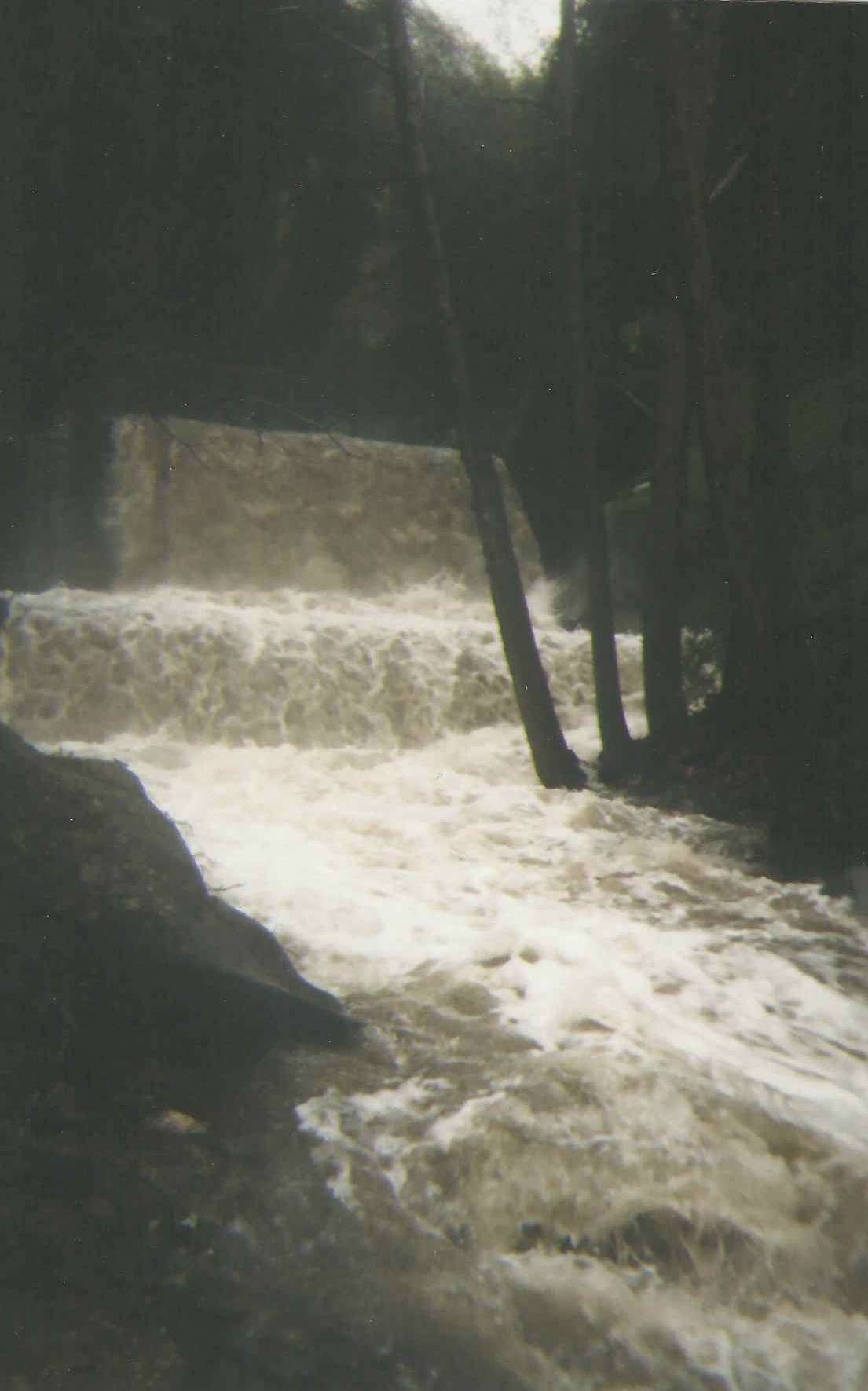
Here's a view of the first Winter Creek check dam upstream from Roberts' Camp. Note the stair-step appearance of the inundated check dam. The larger dam's footing is protected by the smaller sill dam in the foreground. In the great 1969 Flood, also an El Nino year, all the dams in the main Big Santa Anita Canyon, downstream from the confluence of the North Fork, lost their sill dams in just one evening. Sadly, ten cabins also washed away.

Here’s a view of the first Winter Creek check dam upstream from Roberts’ Camp. Note the stair-step appearance of the inundated check dam. The larger dam’s footing is protected by the smaller sill dam in the foreground. In the great 1969 Flood, also an El Nino year, all the dams in the main Big Santa Anita Canyon, downstream from the confluence of the North Fork, lost their sill dams in just one evening. Sadly, ten cabins also washed away.

Here are some photos I took of the Big Santa Anita Canyon ten years ago when Southern California experienced its’ last significant El Nino fall & winter.  Wrightwood & the Big Santa

Our hiking trail (Gabrielino) washed out at this bend in the canyon between Cascade picnic area and Sturtevant Camp. The painstaking process of building a low wall for fill sand has just begun. My wife Joanie & I were running Sturtevant's at the time. Our rain gauge had recorded over 90" before the season was through! Opid's Camp, in the West Fork of the San Gabriel River, recorded over 110" that same winter.

Our hiking trail (Gabrielino) washed out at this bend in the canyon between Cascade picnic area and Sturtevant Camp. The painstaking process of building a low wall for fill sand has just begun. My wife Joanie & I were running Sturtevant’s at the time. Our rain gauge had recorded over 90″ before the season was through! Opid’s Camp, in the West Fork of the San Gabriel River, recorded over 110″ that same winter.

Anita are about 25 air miles apart from one another.  It’s possible to hike (approx. 75 miles)  between Wrightwood and where these winter images were taken out
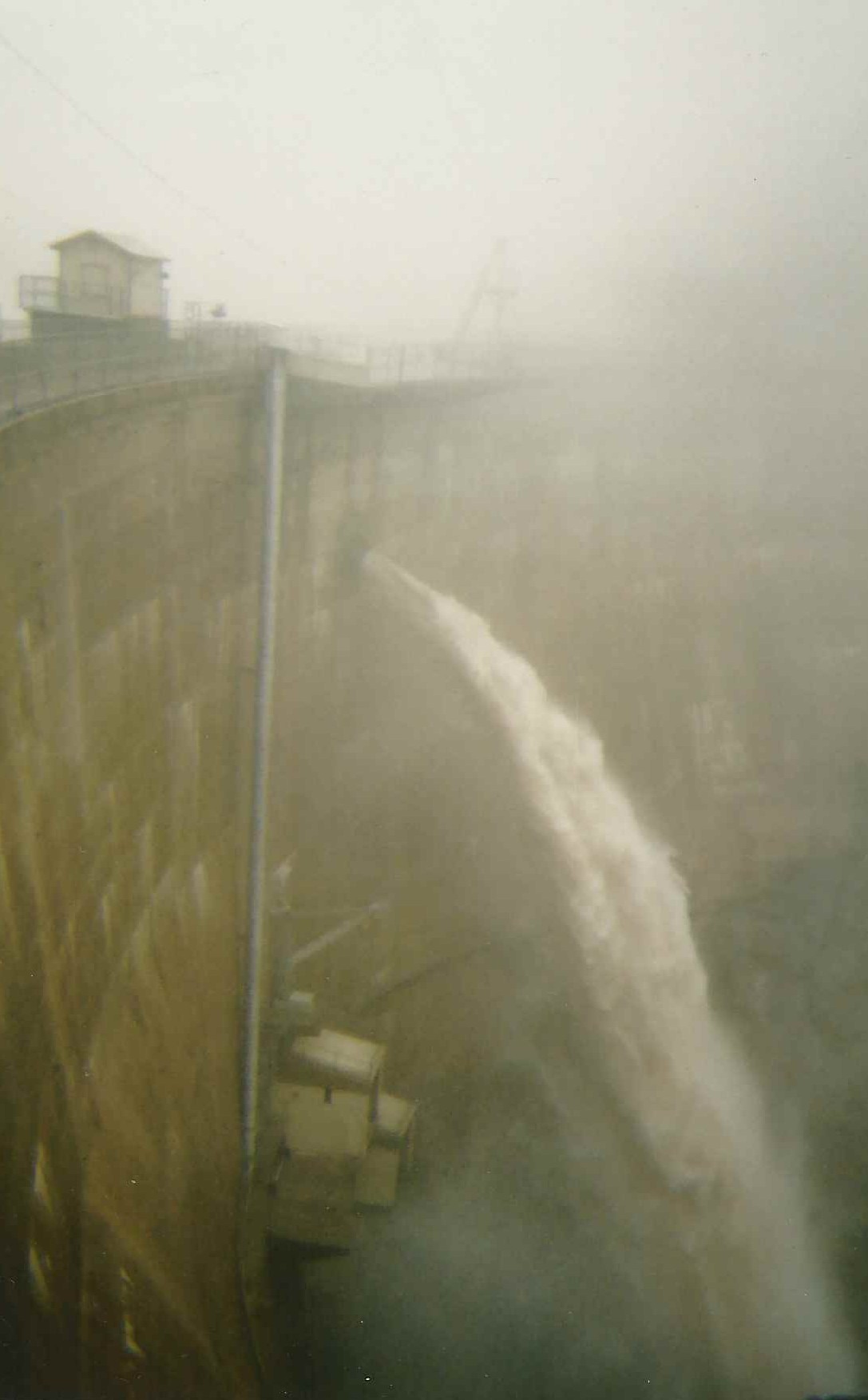
This is a scene of the Big Santa Anita Canyon Dam, located just north of Arcadia, at maximum spill way. Over 1,700 cubic feet of water per second was running through and over the dam the day this photo was taken.

This is a scene of the Big Santa Anita Canyon Dam, located just north of Arcadia, at maximum spill way. Over 1,700 cubic feet of water per second was running through and over the dam the day this photo was taken.

in the Angeles National Forest’s “front country.”  What the two places share, of course, are the San Gabriel Mountains!

When warmish Pacific Ocean storms come in off the coast, it’s the front country that faces the San Gabriel Valley and Los Angeles Basin, that really gets slammed.  You might say that our mountain rain is a text

book example of the orographic phenomena experienced on immeasurable mountain slopes.  If the base of the mountain, L.A. for example, receives an inch of rain, 2000′ upslope you

might receive over two to three inches out of the same storm. The mountainous geography wrings out the clouds as you keep climbing up in elevation.  As a rule, Wrightwood receives about a third of what the front country slopes might

Here's a scene looking up canyon, near Roberts' Camp, Big Santa Anita Canyon. Note the two cabins in the background. These dark trees standing in the tumultuous water are white alders. It is here that I decided to turn around and not continue up canyon. The stream becomes a wall-to-wall situation not too far ahead.

Here’s a scene looking up canyon, near Roberts’ Camp, Big Santa Anita Canyon. Note the two cabins in the background. These dark trees standing in the tumultuous water are white alders. It is here that I decided to turn around and not continue up canyon. The stream becomes a wall-to-wall situation not too far ahead.


get.  When it’s summer time, however, our proximity to the Mojave Desert provides us with thunder storms that the front country can only dream about.  So both sides of the San Gabriels have their give and take when it comes to wet weather.

Big Santa Anita Canyon is not a large watershed at all, say in comparison to the San Gabriel
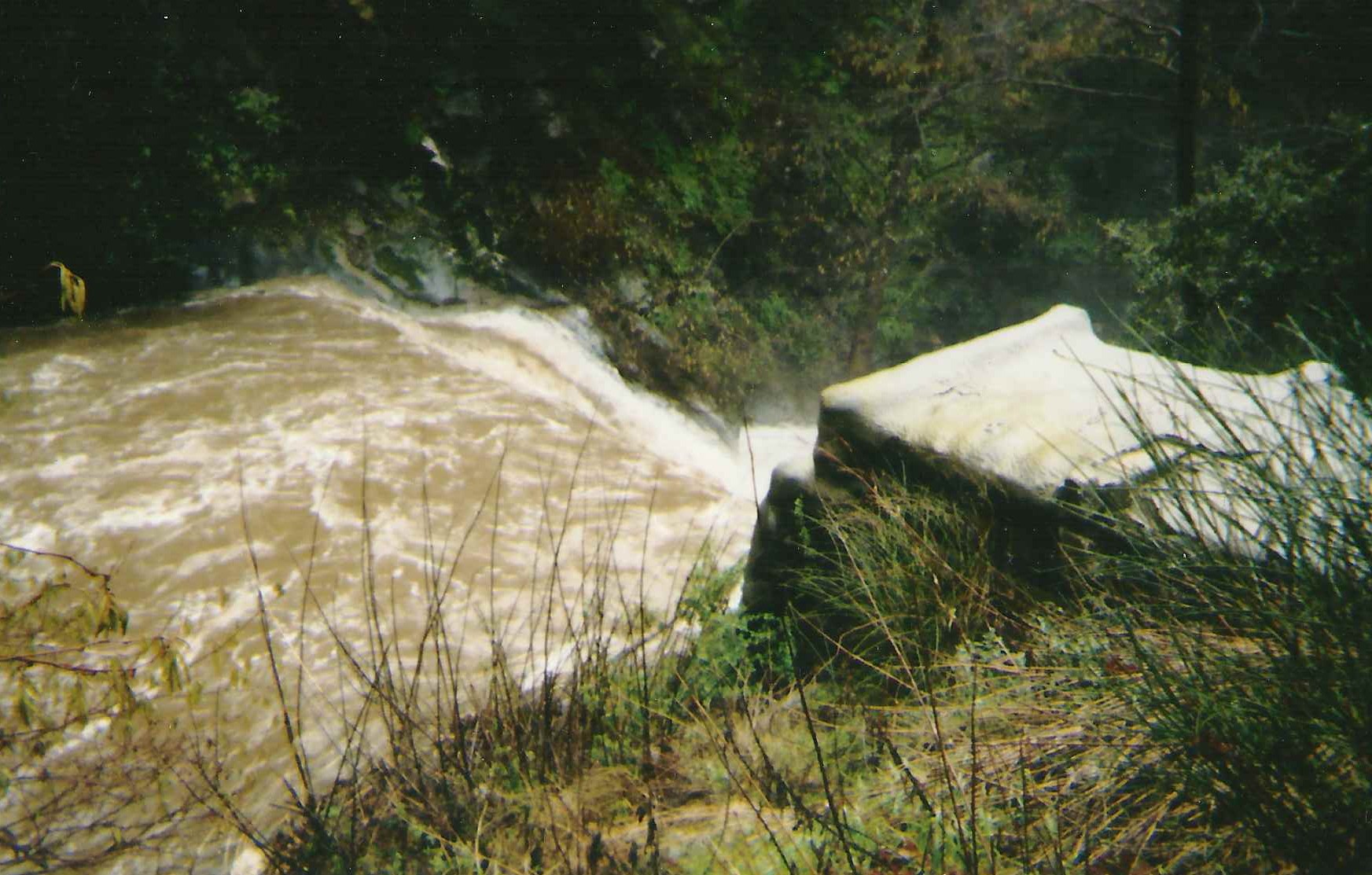
Looking back at the stream as it's about to roll over the top of a check dam. These "check dams" were built throughout many of the Angeles' front-country canyons back in the late 1950's through the late 60's.

Looking back at the stream as it’s about to roll over the top of a check dam. These “check dams” were built throughout many of the Angeles’ front-country canyons back in the late 1950’s through the late 60’s.

River.  Yet, it’s miles of steep terrain can become saturated after days of relentless rainfall.  Generally, the “canyon” can take upwards of a dozen inches of rain over several days before the stream comes up appreciably.  The El Nino storm systems of 2004-2005 sometimes came in one after another, barely allowing more than a half day of blue sky and no time for the moisture to percolate down through the fractured rocky slopes.   These photos show what a front-country stream can become after multiple storms come through, one after another.  What they can’t convey, is the deafening sound, so loud in some cases that it’s impossible to yell across a stream this size and be heard.   When in a little cabin alongside a roaring stream like this one, it’s possible at night, to feel and hear the impact of shifting boulders, jarring up against each other in the dark froth. Scent is a also a highlight of canyons in flood stage.  Organics
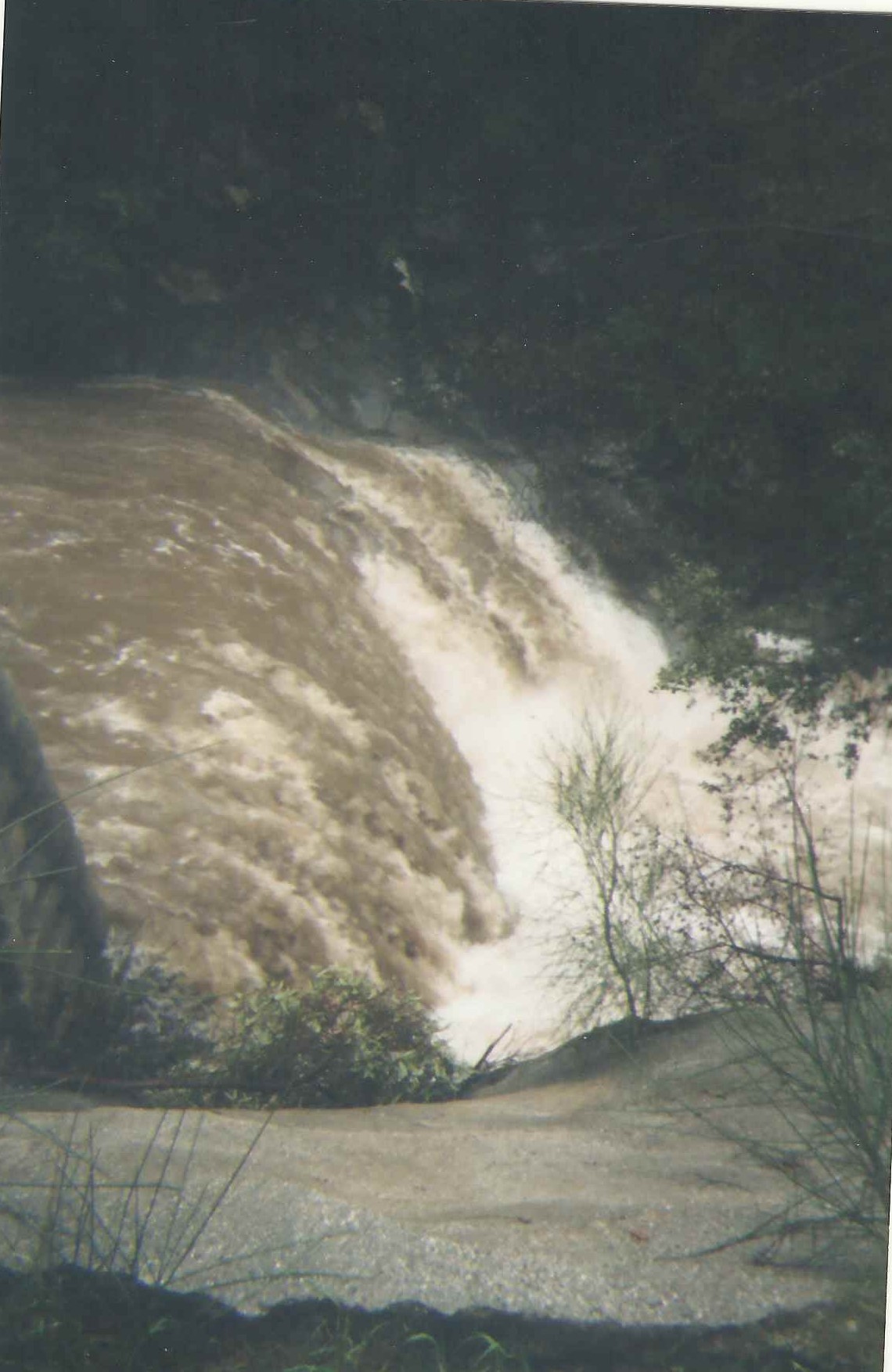
This is how high the streams in the front country can become during a heavy rain season. What you're looking at is a check dam, approximately 50' across in width. This kind of water is nothing to tangle with.

This is how high the streams in the front country can become during a heavy rain season. What you’re looking at is a check dam, approximately 50′ across in width. This kind of water is nothing to tangle with.

locked away in loamy soils along stream banks for years and years are suddenly released.  There’s this olfactory collage of crushed and soaked bay leaves, oak leaves, decomposing vegetation and grinding rock that are seldom experienced in drier times.

by  Chris Kasten

This poem by W.S. Merwin, entitled “Rain Travel”, seems to encapsulate the nocturnal in watery canyons, like the Big Santa Anita, during times like these.

“I wake in the dark and remember it is the morning when I must start by myself on the journey.  I lie listening to the black hour before dawn and you are still asleep beside me while around us the trees full of night lean hushed in their dream that bears us up asleep and awake.  Then I hear drops falling one by one into the sightless leaves and I do not know when they began but all at once there is no sound but rain and the stream below us roaring away in the rushing darkness”.
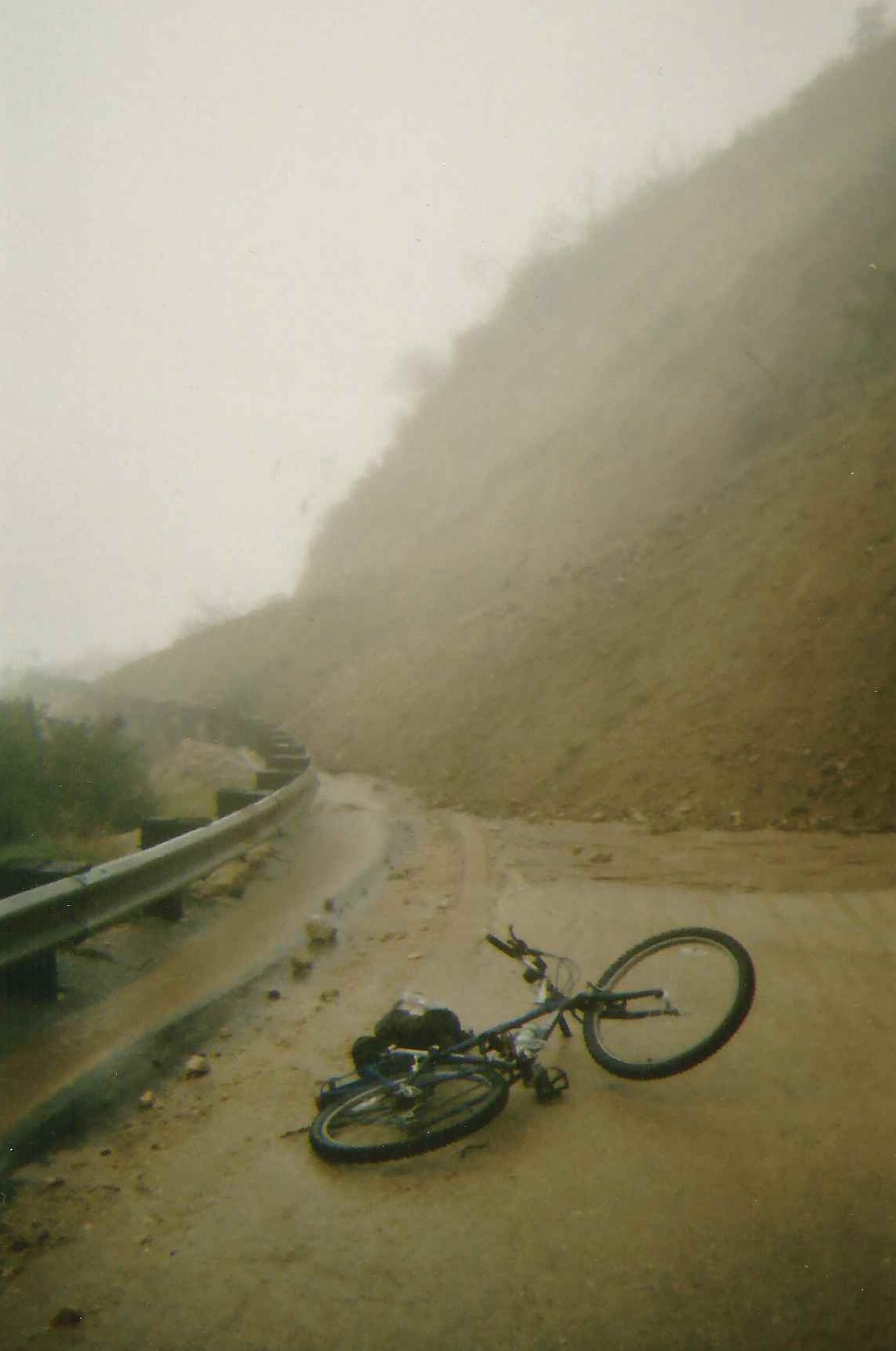
Here's my bike in front of a slide that covered the road while I was photographing the Big Santa Anita during flood stage. Fortunately, my truck was sitting in a friend's drive way in north Arcadia. A number of Forest Service employees had vehicles trapped on the upper end of this and other slides for nearly 10 months!

Here’s my bike in front of a slide that covered the road while I was photographing the Big Santa Anita during flood stage. Fortunately, my truck was sitting in a friend’s drive way in north Arcadia. A number of Forest Service employees had vehicles trapped on the upper end of this and other slides for nearly 10 months!